


 PLATFORM UPDATE:


Improving the conjugation of organic ligands enhances the antenna effect and promotes the luminescence and optical imaging of chiral mononuclear Eu(iii) complexes

Abstract
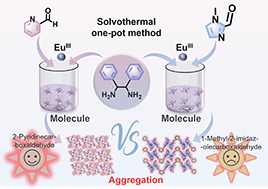
Regulating the conjugated structure of organic ligands to enhance the molar absorption coefficient can effectively promote the energy transfer process of the antenna effect and is one of the most effective ways to construct lanthanide complex emitters with bright luminescence. Herein, 2-pyridinecarboxaldehyde was condensed with (1R,2R/1S,2S)-1,2-diphenylethylenediamine under in situ conditions to form ((1E,1′E)-N,N′-(1,2-diphenylethane-1,2-diyl)bis(1-(pyridin-2-yl)methanimine)) (L2), which was further coordinated with Eu(III) ions to obtain a pair of dynamic chiral mononuclear Eu(III) complex isomers (R/S-Eu) with aggregation-enhanced antenna effect behavior. Remarkably, in the single-molecule state, R/S-Eu exhibit no significant emission, while in the aggregated state, they both exhibit bright red luminescence. Density functional theory (DFT) calculations demonstrate that the energy levels of the ligand L2 closely match those of R-Eu, ensuring efficient ligand–metal energy transfer. The mononuclear Eu(III) complex isomers R/S-Eu exhibited obvious circularly polarized luminescence (CPL) performance, with luminescence asymmetry factors (glum) of 0.072/0.068, 0.159/0.073, and 0.045/0.002 at 511, 523, and 535 nm, respectively. Furthermore, R/S-Eu-DMSO demonstrated high-resolution optical imaging of various living cells and was specifically localized to lysosomal organelles. The chiral complex R-Eu-DMSO was primarily taken up by the zebrafish yolk sac and liver, exhibiting bright red luminescence and excellent optical imaging performance. This work not only provides a new method for improving the photophysical properties of chiral lanthanide complex isomers, but also opens up new horizons for expanding the bio-optical imaging applications of chiral lanthanide complex isomers.
 Please wait while we load your content...


