Copper-catalyzed enantioselective interrupted azide–alkyne cycloaddition to access axially chiral diaryl ethers

Abstract

While transition metal-catalyzed enantioselective azide–alkyne cycloadditions are well-established for accessing 1,4-disubstituted triazoles, the direct enantioselective synthesis of chiral 1,4,5-trisubstituted triazoles from terminal alkynes via an interrupted process remains largely underdeveloped. Herein, we report a copper-catalyzed enantioselective interrupted azide–alkyne cycloaddition. This method enables the facile construction of enantioenriched axially chiral diaryl ethers bearing a 1,4,5-trisubstituted triazole moiety directly from terminal alkynes. Mechanistic studies reveal the absence of a further kinetic resolution process involving the product, underscoring the crucial role of our newly developed chiral ligand L5 in achieving excellent enantiocontrol and yield. The combination of Et3N and LiOtBu is essential for the inhibition of protonated byproducts. The orthogonal reactivity of the residual terminal alkyne and amine groups within the products provides versatile platforms for downstream chemistry, enriching the structural diversity of axially chiral diaryl ethers.
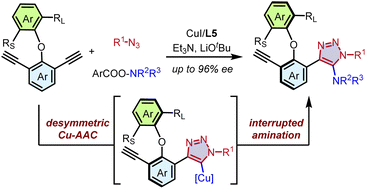
Graphical abstract: Copper-catalyzed enantioselective interrupted azide–alkyne cycloaddition to access axially chiral diaryl ethers

Supplementary files

Article information

Article type
Edge Article
Submitted
06 Dec 2025
Accepted
21 Apr 2026
First published
24 Apr 2026
This article is Open Access

All publication charges for this article have been paid for by the Royal Society of Chemistry
Creative Commons BY-NC license

Chem. Sci., 2026, Advance Article

Copper-catalyzed enantioselective interrupted azide–alkyne cycloaddition to access axially chiral diaryl ethers

R. Wu, L. Chen, Y. Chen, Q. Wu, Q. Chen, A. Lin, H. Yao, Q. Li and S. Gao, Chem. Sci., 2026, Advance Article , DOI: 10.1039/D5SC09566B

This article is licensed under a Creative Commons Attribution-NonCommercial 3.0 Unported Licence. You can use material from this article in other publications, without requesting further permission from the RSC, provided that the correct acknowledgement is given and it is not used for commercial purposes.

To request permission to reproduce material from this article in a commercial publication, please go to the Copyright Clearance Center request page.

If you are an author contributing to an RSC publication, you do not need to request permission provided correct acknowledgement is given.

If you are the author of this article, you do not need to request permission to reproduce figures and diagrams provided correct acknowledgement is given. If you want to reproduce the whole article in a third-party commercial publication (excluding your thesis/dissertation for which permission is not required) please go to the Copyright Clearance Center request page.

Read more about how to correctly acknowledge RSC content.

Social activity

Spotlight

Advertisements