


 PLATFORM UPDATE:

Cooperative metathesis of H–H/Sn–CAr bonds in stannylene-Ni0 systems

Abstract
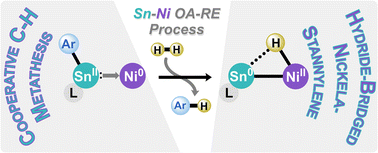
The reaction of phosphine-appended (amido)(aryl)stannylenes (1) with Ni0 synthons leads to the facile formation of chelating-stannylene Ni0 complexes (2–4). Utilising the carbene-stabilised synthon IPr·Ni·(η6-toluene) (IPr = [(H)CN(Dipp)]2C:; Dipp = 2,6-iPr2C6H3) leads to the high-yielding formation of targeted 16-electron Ni0 complexes. These systems activate H2 under non-forcing conditions (1 bar, RT), all forming the same single product, 5, which is found to be a mono-hydrido stannylene complex. Alternative synthetic routes in combination with computational calculations demonstrate that this species features a bridging (i.e. [Sn-(µ-H)-Ni]) hydride ligand, and may be described either as an agostic [Sn–H–Ni] bonded hydrido-stannylene complex, or a formal nickelo-stannylene. The formation of compound 5 arises from the metathesis of the Sn–CAr bonds with H2, leading to the elimination of Ar–H, which is detected by NMR and mass spectroscopic methods. The mechanism for this process, explored using DFT methods, proceeds through Ni-centre H2 binding, Sn–Ni cooperative hydrogen activation, and subsequent Ar–H elimination via a cooperative C–H bond formation at the Ni and Sn centres. Finally, complex 5 is shown to undergo further Ph-H elimination of a single aryl group of the chelating phosphine arm with the bridging hydride ligand, forming a unique nickelo-stannylene complex 7, which features two formally Sn0 metallostannylene centres binding NiII.
- This article is part of the themed collections: 2026 Chemical Science Covers and #MyFirstChemSci 2026
 Please wait while we load your content...


