


 PLATFORM UPDATE:


Polarization-induced reversible electron–hole migration and redox reaction switching in ferroelectric single-atom photocatalysts
 *c
and
Jinlong
Yang
c
*c
and
Jinlong
Yang
c
Abstract
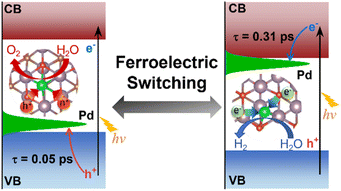
Photocatalysts capable of switching between oxidation and reduction reactions at a single active site can efficiently harness solar energy to selectively generate target products on demand, and are thus eagerly pursued. However, realizing such photocatalysts is quite challenging due to the difficulty in simultaneously accumulating both types of carriers at a single site and meeting the stringent requirements for electron–hole separation. Here, we propose that the switchable out-of-plane polarization of two-dimensional ferroelectric materials can reversibly steer either photogenerated electrons or holes to single active sites, and further enable controllable switching of photocatalytic oxidation and reduction. The first-principles calculations and nonadiabatic molecular dynamics simulations, performed on a photocatalyst comprising a Pd single-atom anchored on a ferroelectric Sc2CO2 monolayer, validate this strategy. Reversing the ferroelectric polarization direction in Sc2CO2 modulates carrier migration: an upward polarization state induces ultrafast hole accumulation at the Pd site (τ = 0.05 ps), whereas a downward polarization state drives rapid electron transfer to the Pd site (τ = 0.31 ps). Moreover, the Pd site exhibits low hydrogen and oxygen evolution reaction overpotentials (0.08 V and 0.29 V), enabling efficient overall water splitting. The proposed strategy establishes a novel avenue for precisely controlled photochemical synthesis at single active sites.
 Please wait while we load your content...


