


 PLATFORM UPDATE:


Triplet states enable efficient photocatalytic hydrogen evolution in star-shaped truxene-based nanoparticles

Abstract
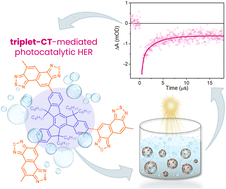
We have developed two new star-shaped donor–acceptor oligomers, named TxBT and TxNT, with a truxene donor core and either 2,1,3-benzothiadiazole (BT) or a naphtho[1,2-c:5,6-c′]bis[1,2,5]thiadiazole (NT) unit, respectively. Femtosecond transient absorption spectroscopy suggested that both oligomer nanoparticles (NPs) generate long-lived triplet charge-transfer (CT) states following photoexcitation, which undergo reductive quenching by ascorbate. TxNT NPs generate a larger population of reduced species that accumulate and escape recombination compared to TxBT NPs, indicating more efficient charge separation. TxNT NPs show significantly higher hydrogen evolution rate (54 mmol h−1 g−1) compared to TxBT NPs, which is comparable to the performance of the most efficient heterojunction polymer NP systems. Additionally, morphological analysis revealed that Pt deposition was significantly lower on TxBT than on TxNT NPs. These findings highlight the critical role of triplet CT states, tuning molecular energy levels, optimizing excited-state dynamics, and engineering NP architecture to increase photocatalytic hydrogen evolution of organic photocatalysts. To our knowledge, this is the first report where triplet CT states can mediate photocatalytic hydrogen evolution in donor–acceptor oligomer NPs.
 Please wait while we load your content...


