


 PLATFORM UPDATE:


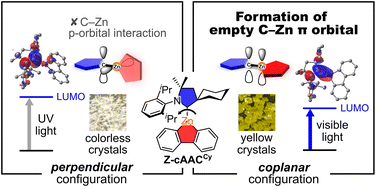
Zincafluorene complex with an empty C–Zn π orbital that captures visible light
 ab
and
Yoshimasa
Wada
*ab
ab
and
Yoshimasa
Wada
*ab
Abstract
Zinc complexes are attractive candidates for photofunctional materials owing to the low cost and benign nature of Zn, yet directly engaging Zn orbitals in visible-light responses has remained elusive in mononuclear systems. Here, we realize this by engineering an empty C–Zn π orbital as the LUMO in carbene–zincafluorene frameworks, as demonstrated in three newly designed mononuclear Zn complexes. Selective recrystallization of one complex afforded two conformational polymorphs, enabling us to establish a clear correlation among carbene–zincafluorene coplanarity, formation of the empty C–Zn π orbital, LUMO lowering, and visible-light absorption. Natural atomic orbital analyses of the complexes indicate that tuning the carbene scaffold improves C(2p)/Zn(4p) energy-level matching and thereby increases Zn(4p) participation in the LUMO. Additionally, one complex exhibits bright room-temperature phosphorescence in the solid state with a PL quantum yield of 21% and an emission lifetime of 2.0 ms; theoretical calculations including spin–orbit coupling identify the Zn center as a key contributor to the emission. As a proof-of-concept for visible-light responsive photofunctional application, the same complex catalyzes stilbene isomerization under blue-LED irradiation. These results highlight the non-innocent role of Zn in visible-light responses and pave the way toward photoactive mononuclear Zn complexes.
- This article is part of the themed collections: 2026 Chemical Science HOT Article Collection and 2026 Chemical Science Covers
 Please wait while we load your content...


