


 PLATFORM UPDATE:


Unlocking radical reactivity of cyclic diaryl λ3-chloranes through NHC-catalyzed three-component coupling

Abstract
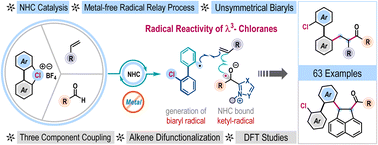
Hypervalent halogens are central to contemporary organic synthesis, yet hypervalent chloranes, particularly cyclic λ3-chloranes, remain markedly underexplored, despite their unique electronic properties imparted by the highly electronegative chlorine atom. To date, their radical reactivity has not been documented. Herein, we report the first radical reaction of cyclic diaryl λ3-chloranes, enabled by N-heterocyclic carbene (NHC) catalysis in a three-component reaction with aromatic aldehydes and olefins at room temperature. This strategy leverages the strong reducing power of the NHC-derived Breslow enolate to generate a biaryl radical from λ3-chlorane, initiating a radical relay that culminates in regioselective vicinal aroylarylation of olefins. This transition-metal-free methodology provides streamlined access to ortho-substituted unsymmetrical biaryls in high yields, with broad functional group tolerance and compatibility with biorelevant scaffolds. Mechanistic insights from DFT calculations reveal that the key single-electron transfer (SET) from Breslow enolate to λ3-chlorane is a barrierless process, markedly distinct from that of the analogous λ3-bromane and λ3-iodane species. The favorable kinetics of the radical relay event and the thermodynamic stability of the aroylarylated products drive the reaction selectively along the desired three-component pathway.
 Please wait while we load your content...


