


 PLATFORM UPDATE:


Deep excitation afterglow luminescent probes for biomedical applications
 *a
Chao
Wang,
a
Pu
Chen,
*d
Jonathan L.
Sessler,
*e
Bo
Tang,
*f
Tony D.
James
*bh
and
Guang
Chen
*a
*a
Chao
Wang,
a
Pu
Chen,
*d
Jonathan L.
Sessler,
*e
Bo
Tang,
*f
Tony D.
James
*bh
and
Guang
Chen
*a
Abstract
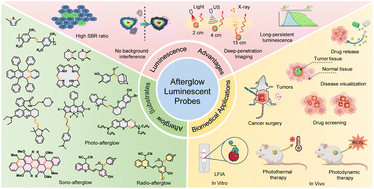
In addition to the high sensitivity, excellent spatio-temporal resolution and powerful real-time imaging capabilities, biomedical applications impose high demands on imaging techniques. Unfortunately, conventional imaging relies on the real-time excitation and suffers from limited tissue penetration. In contrast, afterglow imaging can provide continuous and deep luminescence once the probe is excited by NIR-light, X-ray or ultrasound. As such, it can effectively avoid autofluorescence and improve the imaging sensitivity and signal-to-background ratio. Moreover, X-ray-activated afterglow probes benefit from enhanced depth of penetration, thereby allowing more effective imaging of deep-seated lesions. Such advantages have attracted the interest of researchers, which should speed up the translation of biomedical afterglow research for clinical applications. With this perspective, we provided a comparative and analytical summary of the latest advances while highlighting the most promising afterglow probes. This perspective also outlines forward-looking strategies for molecular design, working mechanisms, and clinical prospects. Moreover, future challenges and research directions are discussed. As such this perspective describes how to formulate the most promising chemical strategies through mechanistic understanding, molecular design, and functional integration, thereby maximizing the successful development of clinical probes for visualization in humans.
- This article is part of the themed collections: 2026 Chemical Science Perspective & Review Collection and Imaging, biosensing and diagnostics: 2025 Chemical Science symposium collection
 Please wait while we load your content...


