


 PLATFORM UPDATE:


Synergistic strategy of interfacial ion channels and a cross-linked network in a composite electrolyte for dendrite-free sodium-metal batteries

Abstract
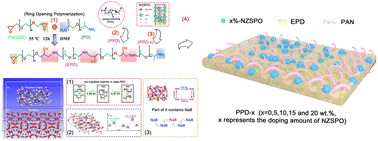
Solid-state electrolytes (SSEs) can address the safety concerns of liquid electrolytes in sodium-metal batteries, but their low ionic conductivity and high interfacial resistance limit practical use. To tackle these problems, this study develops a flexible and tunable composite solid electrolyte (CSE) by integrating Na3Zr2Si2PO12 (NZSPO) active fillers into a polymer matrix that combines the high dielectric constant of polyacrylonitrile (PAN) with an interpenetrating and cross-linked polyethylene oxide (PEO) network. The resulting electrolyte achieved a high Na+ transference number of 0.64 and an exceptional ionic conductivity of >1.2 × 10⁻³ S cm−1 at 30 °C. It enabled stable Na plating/stripping for over 2500 hours in symmetric cells, and when paired with a Na3V2(PO4)3 (NVP) cathode, delivered outstanding cycling stability (95.2 mAh g−1 after 500 cycles at 0.5C) with an ultra-low decay rate of 0.029% per cycle due to the good interface contact based on the good external flexibility and high internal mechanical stability of the composite solid electrolyte. Theoretical calculation has demonstrated that Na+ cations have low transferring energy barriers in both NZSPO particles and the polymer matrix. The work highlights a synergistic filler–polymer strategy for advancing solid-state batteries.
 Please wait while we load your content...


