


 PLATFORM UPDATE:


Chirality-induced stereoselective synthesis of chiral sp2-carbon-conjugated covalent organic frameworks
 *a
*a
Abstract
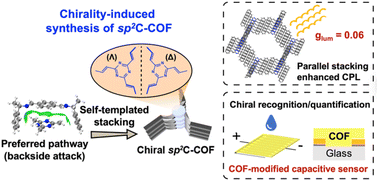
A fully conjugated sp2-carbon covalent organic framework (sp2C-COF) possessing global conformational chirality holds great promise for advanced electronic devices. However, the inherent irreversibility of many reactions hinders the chirality-induced synthesis of COFs from achiral building blocks. Herein, we address a chirality-induced linkage exchange strategy to fabricate a vinylene-linked chiral sp2C-COF via an irreversible aldol reaction. The approach involves the pre-synthesis of a chiral Schiff-base precursor, followed by its acid-catalyzed conversion from imine to vinylene linkages. This chiral precursor induces the orientation of asymmetric vinylene linkages, enabling the enantioselective formation of periodic frameworks. Through a self-template mechanism, the layered stacking amplifies the structural chirality and dominates the evolution of branched nanofibers. The resulting chiral sp2C-COF exhibits a high dissymmetry factor in circularly polarized luminescence along with a substantial quantum yield, achieving a superior figure of merit of up to 0.01. An ultrathin film of the chiral sp2C-COF is fabricated and implemented in an interdigitated capacitive sensor capable of the simultaneous quantification and chiral recognition of tryptophan within the 10–40 µM range. This work not only provides a strategic pathway to overcome chiral propagation barriers in irreversible reactions but also introduces an emerging class of chiral two-dimensional carbon materials.
- This article is part of the themed collection: 2026 Chemical Science HOT Article Collection
 Please wait while we load your content...


