


 PLATFORM UPDATE:


Digital materials ecosystem: from databases to AI agents for autonomous discovery
 a
Xue
Jia,
a
Heng
Liu,
a
Qian
Wang,
a
Seong-Hoon
Jang,
a
Daksh
Shah,
a
Hung Ba
Tran
a
and
Hao
Li
*a
a
Xue
Jia,
a
Heng
Liu,
a
Qian
Wang,
a
Seong-Hoon
Jang,
a
Daksh
Shah,
a
Hung Ba
Tran
a
and
Hao
Li
*a
Abstract
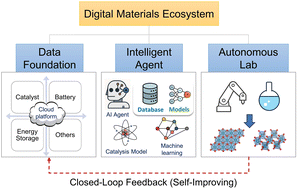
The concept of a digital materials ecosystem represents a new paradigm in materials research, where data, theory, and automation are integrated into a unified and iterative framework. By combining reliable databases, physical frameworks, and intelligent data analysis, materials discovery is evolving from empirical exploration toward a systematic and predictive science. The rapid growth of data and artificial intelligence (AI) has enabled the identification of complex structure–property relationships, while advances in automated synthesis and high-throughput characterization are closing the loop between prediction and validation. Looking forward, the field must focus on building trustworthy and benchmarked datasets, developing interpretable and high-precision models, and designing AI tools that embody human scientific reasoning. Equally important is ensuring standardization and consistency between digital inputs and experimental responses. Together, these efforts will transform materials discovery from data accumulation into genuine knowledge generation, paving the way for an autonomous and self-improving research ecosystem that accelerates both fundamental understanding and technological innovation.
- This article is part of the themed collections: 2026 Chemical Science Perspective & Review Collection and 2026 Chemical Science Covers
 Please wait while we load your content...


