Dock & Design: Engineering specificity for alternative pimaradiene outcome with the ent-kaurene synthase from Bradyrhizobium japonicum

Abstract

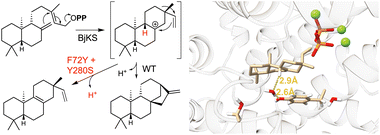
The complexity of the reactions catalyzed by terpene synthases has hindered enzymatic engineering. In most cases such efforts result in non-specific product outcome, with the targeted compound being produced alongside others, hindering further use. Previous work with the structurally characterized ent-kaurene synthase from Bradyrhizobium japonicum (BjKS) identified a serine for alanine substitution (A167S) that lead to premature deprotonation, yielding a pair of ent-pimaradiene double-bond isomers, with retrospective analysis by the TerDockin computational approach indicating the introduced hydroxyl acts as a catalytic base for both.Here this route to 'short-circuiting' the BjKS catalyzed reaction for ent-pimaradiene production was further explored, with prospective application of TerDockin, via design-build-test cycles, enabling specific production of a novel pimaradiene isomer via introduction of a water as the catalytic base. The resulting mutants, BjKS:F72S and particularly BjKS:F72Y/Y280S specifically yield the targeted ent-pimara-8,15-diene with reasonable catalytic efficiency, demonstrating the applicability of this computationally inexpensive approach to engineering terpene synthase product outcome.

Supplementary files

Article information

Article type
Edge Article
Submitted
24 Nov 2025
Accepted
25 Mar 2026
First published
26 Mar 2026
This article is Open Access

All publication charges for this article have been paid for by the Royal Society of Chemistry
Creative Commons BY-NC license

Chem. Sci., 2026, Accepted Manuscript

Dock & Design: Engineering specificity for alternative pimaradiene outcome with the ent-kaurene synthase from Bradyrhizobium japonicum

M. Schmidt-Dannert, Y. Zhang, L. Jin, Q. Wang, S. Tufts, M. Jia, D. J. Tantillo, J. B. Siegel and R. J. Peters, Chem. Sci., 2026, Accepted Manuscript , DOI: 10.1039/D5SC09199C

This article is licensed under a Creative Commons Attribution-NonCommercial 3.0 Unported Licence. You can use material from this article in other publications, without requesting further permission from the RSC, provided that the correct acknowledgement is given and it is not used for commercial purposes.

To request permission to reproduce material from this article in a commercial publication, please go to the Copyright Clearance Center request page.

If you are an author contributing to an RSC publication, you do not need to request permission provided correct acknowledgement is given.

If you are the author of this article, you do not need to request permission to reproduce figures and diagrams provided correct acknowledgement is given. If you want to reproduce the whole article in a third-party commercial publication (excluding your thesis/dissertation for which permission is not required) please go to the Copyright Clearance Center request page.

Read more about how to correctly acknowledge RSC content.

Social activity

Spotlight

Advertisements