


 PLATFORM UPDATE:

Tunable axial symmetry β-ketoamine covalent organic frameworks for efficient photocatalytic H2O2 synthesis in seawater

Abstract
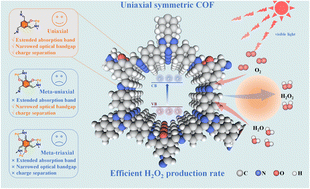
Photocatalytic production of hydrogen peroxide (H2O2) from seawater represents a sustainable approach for solar energy conversion. However, complex ionic composition hinders charge transport and accelerates catalyst degradation, undermining efficiency and posing a major challenge to the development of effective photocatalysts. Here, we explore the role of axial symmetry in stabilized β-ketoamine covalent organic frameworks (COFs) for efficient seawater photocatalysis. Three COFs with identical chemical compositions but distinct symmetries, uniaxial (1KtTb), meta-uniaxial (2KtTb), and meta-triaxial (3KtTb), were synthesized. Comprehensive experiments and theoretical analyses reveal that axial symmetry significantly influences light absorption, photocarrier recombination, and the energy barriers of key intermediate pathways (*OOH and *OH). The uniaxial symmetric framework exhibits a narrower bandgap, improved charge separation, and lower reaction barriers, enabling enhanced solar utilization and photocatalytic performance. In real seawater tests from the Zhoushan Sea, the uniaxial symmetric COF achieved record H2O2 production rates of 12 865.2 µmol g−1 h−1 under oxygen and 8557.4 µmol g−1 h−1 in air, with over 90% activity retained after 20 cycles and 30 days of immersion. Our results demonstrate the application potential of structural symmetry in photocatalysis and guide the design of marine-adapted COFs for efficient H2O2 synthesis and photoelectric conversion.
 Please wait while we load your content...


