


 PLATFORM UPDATE:


Interplay between ligand field strength and the nephelauxetic effect in chromium(iii) complexes with anionic amido ligands

Abstract
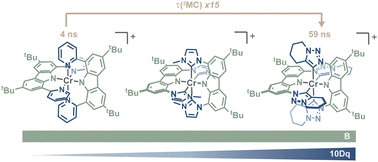
Incorporation of the nephelauxetic effect into ligand design enabled red-shifting of spin-flip transitions of CrIII and MnIV complexes into the near-infrared region. Using carbazolide complexes as a model, we present a strategy for tuning the ratio of ligand field strength to the Racah parameter B by combining a covalent carbazolide core with variable σ-donor ligand “side arms.” Substitution of pyridine, as in [Cr(Lpy)2]+ ([Lpy]− = 3,6-di-tert-butyl-1,8-di(pyridin-2-yl)carbazol-9-ide), with stronger σ-donors such as N-heterocyclic or mesoionic carbenes in [Cr(LNHC)2]+ or [Cr(LMIC)2]+ ([LNHC]− = 3,6-di-tert-butyl-1,8-bis(imidazolin-2-yliden-1-yl)carbazolide and [LMIC]− = 3,6-di-tert-butyl-1,8-bis(4,5,6,7-tetrahydro-2H-[1,2,3]triazolo[1,5-a]pyridin-2-yl)-carbazol-9-ide) increased the ligand field strength from 17 500 to 24 400 cm−1, with only a modest rise in B from 550 to 600 cm−1. This balance favors near-infrared spin-flip transitions while extending their excited-state lifetimes. Despite these advances, carbazolide-based ligands exhibit also drawbacks, including low-lying charge-transfer states and geometric distortions, which limit lifetimes and prevent emission, contrasting with other near-infrared-emissive CrIII systems. Additionally, we demonstrate an approach for estimating energies of dark, low-energy spin-flip states in CrIII complexes via photoinduced electron transfer and Rehm–Weller analysis. Our results offer guidance on balancing ligand field strength and metal–ligand bond covalency to optimize the photophysical and photochemical properties of first-row transition metal complexes.
 Please wait while we load your content...


