


 PLATFORM UPDATE:


Deciphering the molecular origin of the 19.3 eV electronic excitation energy of H3+
 †ab
Jakob K.
Staab,
†ac
Eduard
Matito,
de
Cina
Foroutan-Nejad
f
and
Henrik
Ottosson
*a
†ab
Jakob K.
Staab,
†ac
Eduard
Matito,
de
Cina
Foroutan-Nejad
f
and
Henrik
Ottosson
*a
Abstract
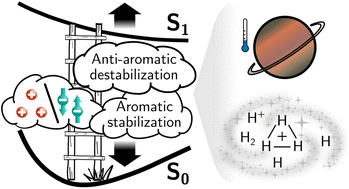
The trihydrogen cation, H3+, is unique in the Universe. It serves as the primary proton reservoir, driving essential astrochemical reactions, and it functions as a thermostat for giant gas planets. H3+ has also a remarkably low photodissociation rate, explained by its exceptionally high first electronic excitation energy (19.3 eV), which is well above the ionization energy of the much more abundant monohydrogen (13.6 eV). Herein we reveal that the key factors behind the high excitation energy of H3+, and thus, its astrophotochemical inertness, are: (i) aromatic stabilization in its electronic ground state, (ii) antiaromatic destabilization in its first excited state, and (iii) a high nuclear-to-electronic charge ratio (+3 vs. −2). Through comparisons with analogous (isolobal) π-conjugated carbocations, we find that ground state aromatic stabilization plus excited state antiaromatic destabilization raise the excitation energy of H3+ by 4.8–6.0 eV. This means that for H3+, the excited state antiaromatic character (which normally leads to high photoreactivity) contributes to its astrophotochemical inertness. Thus, only with the increase in excitation energy due to ground state aromaticity plus excited antiaromaticity can H3+ act as a thermostat for giant gas planets and as a proton reservoir that drives astrochemical reactions, thereby fulfilling its unique role in space.
 Please wait while we load your content...


