


 PLATFORM UPDATE:


Ladder-type π-conjugated frameworks with multi-heteroatom modulation for narrowband violet-blue multiple-resonance emitters with a low CIEy of 0.03
 †a
Shi-Jie
Ge,
a
Yang-Kun
Qu,
a
Dong-Ying
Zhou,
a
Liang-Sheng
Liao
ab
and
Zuo-Quan
Jiang
*a
†a
Shi-Jie
Ge,
a
Yang-Kun
Qu,
a
Dong-Ying
Zhou,
a
Liang-Sheng
Liao
ab
and
Zuo-Quan
Jiang
*a
Abstract
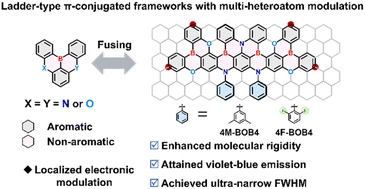
The development of violet-blue organic light-emitting diodes (OLEDs) with narrowband emission, high color purity and efficiency remains a formidable challenge, particularly under the stringent requirements of the wide-color-gamut display standards. Here, we propose a molecular design strategy that integrates oxygen-bridged triarylboron π-extension with precise heteroatom modulation to construct tetraboron-based MR-TADF emitters 4M-BOB4 and 4F-BOB4. The emitters adopt a ladder-type fused framework with a highly ordered arrangement of boron, nitrogen, and oxygen atoms, while fluorine substitution shifts the emission region from deep-blue to violet-blue. The incorporation of oxygen atoms not only regulates electronic delocalization and frontier orbital distribution, but also contributes to sharpening the emission bandwidth through localized conjugation modulation. As a result, 4F-BOB4 exhibits ultra-narrow emission in solution (with a full-width at half maximum of 14 nm), and corresponding OLED devices exhibit a maximum external quantum efficiency (EQEmax) of 20.9%. Notably, the device based on 4F-BOB4 exhibits a CIEy value ≤0.030, underscoring its status as one of the most color-pure violet-blue emitters reported to date. This work highlights the potential of rational π-framework engineering and localized electronic modulation as a generalizable approach to next-generation high-performance narrowband OLEDs.
 Please wait while we load your content...


