


 PLATFORM UPDATE:


Atomic-scale redox-potential-mediated engineering of 0D/2D Cu–Cu2O/MOx(OH)y heterojunctions for efficient nitrate electroreduction to ammonia
 a
Baodui
Wang
*a
a
Baodui
Wang
*a
Abstract
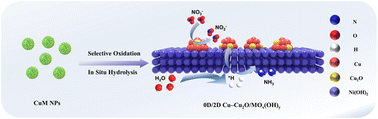
The precise construction of zero-dimensional/two-dimensional (0D/2D) heterojunctions is often hindered by interfacial lattice mismatches and uncontrolled phase transitions, limiting their efficacy in electrocatalysis. Herein, we report a widely applicable redox-potential-mediated strategy for the atomically defined fabrication of 0D/2D Cu–Cu2O/MOx(OH)y heterojunctions (M = Ni, Fe, Mn, Co, Cr). This approach leverages the inherent differences in standard reduction potentials between Cu and transition metals to drive selective oxidation and ultrasound-assisted hydrolysis of pre-synthesized CuM alloy nanoparticles. This process results in situ phase separation, forming epitaxially embedded Cu–Cu2O nanoparticles within ultrathin MOx(OH)y nanosheets. As a proof of concept, the Cu–Cu2O/Ni(OH)2 heterojunction exhibits exceptional performance in the electrocatalytic nitrate reduction reaction (eNITRR), achieving an outstanding ammonia yield rate of 12,974.5 µg cm−2 h−1 (at a mass loading of 1 mg cm−2) and a Faradaic efficiency of 98.15%, ranking it among the high-performing catalysts reported to date. Mechanistic studies reveal a synergistic interfacial effect: Cu–Cu2O promotes nitrate adsorption and activation, while Ni(OH)2 selectively cleaves H2O to generate reactive *H species, thereby accelerating the hydrogenation steps. This redox-guided synthesis provides a useful framework for the atomic-scale engineering of heterointerfaces, paving the way for advanced electrocatalysts in sustainable nitrogen valorization and beyond.
 Please wait while we load your content...


