Large-scale protein conformational transitions revealed by weighted ensemble simulations and EPR

Abstract

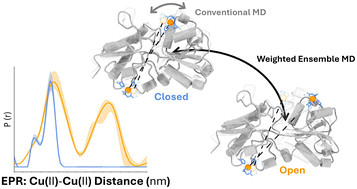
Large-amplitude protein conformational changes are essential for cellular processes. Electron paramagnetic resonance (EPR) spectroscopy can detect such conformational changes by measuring distances between site-directed spin labels, but lacks atomistic detail. While standard MD simulations provide atomistic details, the relevant timescales are often inaccessible. Here, we combine weighted ensemble path sampling with EPR distances to capture long-timescale protein conformational transitions in an unbiased manner. We simulated hundreds of pathways for a large-scale conformational transition between the closed and open states of the lysine/arginine/ornithine binding protein (LAOBP). Furthermore, we identified key residue-level interactions that distinguish the two states. Selective mutagenesis of these residues leads to stabilization of the open state of the protein. This approach integrates sparse EPR distances with atomistic simulations, revealing hidden protein states that evolve on milliseconds to seconds timescales.

Supplementary files

Transparent peer review

To support increased transparency, we offer authors the option to publish the peer review history alongside their article.

View this article’s peer review history

Article information

Article type
Edge Article
Submitted
17 Nov 2025
Accepted
26 Mar 2026
First published
26 Mar 2026
This article is Open Access

All publication charges for this article have been paid for by the Royal Society of Chemistry
Creative Commons BY-NC license

Chem. Sci., 2026, Accepted Manuscript

Large-scale protein conformational transitions revealed by weighted ensemble simulations and EPR

S. Palit, D. Yang, X. Bogetti, A. Bogetti, O. Wood, S. Saxena and L. Chong, Chem. Sci., 2026, Accepted Manuscript , DOI: 10.1039/D5SC08971A

This article is licensed under a Creative Commons Attribution-NonCommercial 3.0 Unported Licence. You can use material from this article in other publications, without requesting further permission from the RSC, provided that the correct acknowledgement is given and it is not used for commercial purposes.

To request permission to reproduce material from this article in a commercial publication, please go to the Copyright Clearance Center request page.

If you are an author contributing to an RSC publication, you do not need to request permission provided correct acknowledgement is given.

If you are the author of this article, you do not need to request permission to reproduce figures and diagrams provided correct acknowledgement is given. If you want to reproduce the whole article in a third-party commercial publication (excluding your thesis/dissertation for which permission is not required) please go to the Copyright Clearance Center request page.

Read more about how to correctly acknowledge RSC content.

Social activity

Spotlight

Advertisements