


 PLATFORM UPDATE:


DSSA-PPI: enhancing binding affinity change prediction upon protein mutations using disentangled structure–sequence aware attention

Abstract
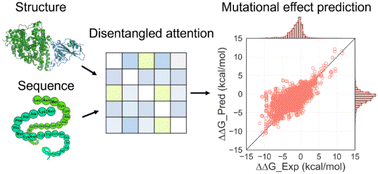
Accurate assessment of the effects of mutations on protein–protein interactions (PPIs) is crucial for understanding disease pathogenesis and the development of targeted therapies. Here, we present DSSA-PPI, a hybrid deep learning framework that enhances the prediction of mutation-induced binding affinity changes (ΔΔG) by leveraging structural and sequence information through a disentangled attention mechanism. Building upon the complementary strengths of a geometric equivariant graph neural network PPIFormer and a protein language model ESM-2, our framework employs a novel representation learning strategy that integrates sequence- and structure-specific contributions, thereby improving the precision of PPI ΔΔG predictions. DSSA-PPI demonstrates robust performance across diverse mutational contexts on the standard protein binding affinity SKEMPI v2 dataset and outperforms existing methods on multiple benchmarks under identical cross-validation. In a case study of the SARS-CoV-2 receptor-binding motif (RBM) interaction with angiotensin-converting enzyme 2 (ACE2), our model accurately identifies top-ranking mutations that enhance binding affinity. Additionally, it guided the optimization of a peptide inhibitor, improving its inhibitory activity against activated factor XI (FXIa) by over 40-fold. These results highlight DSSA-PPI as a versatile and reliable tool for predicting mutation-induced perturbations in PPIs.
 Please wait while we load your content...


