


 PLATFORM UPDATE:


Programmable self-destruction of artificial cells with death signaling

Abstract
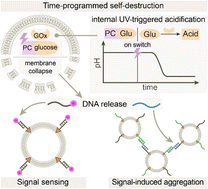
Programmed cell death is a crucial biological process that removes damaged or no longer needed cells and is orchestrated through complex intracellular signaling cascades. Mimicking such behavior in synthetic systems enables programmed disassembly after completing a task or releasing cargo on demand. Despite advances in engineering artificial cells (ACs) that mimic key cellular functions such as metabolism, homeostasis or communication, systems with a programmable lifetime remain unrealized. Here, we introduce a time-programmed self-destruction mechanism in ACs based on pH-responsive giant unilamellar vesicles, equipped with an internal UV-inducible acidification cascade. Upon light activation, photocaged glucose is enzymatically converted to gluconic acid, lowering the internal pH and destabilizing the pH-sensitive membrane, ultimately causing complete membrane collapse. The self-destruction is spatially confined and tunable in time, ranging from minutes to over an hour, depending on the light intensity. Furthermore, we demonstrate that collapse-induced release of DNA signals triggers defined downstream responses in neighboring ACs, including membrane labeling and aggregation. Our findings pave the way for ACs with programmed lifetimes, capable of on-demand release or disassembly in response to defined stimuli, allowing transmission of signals within complex synthetic environments.
 Please wait while we load your content...


