


 PLATFORM UPDATE:

Zero-trigger ultrafast charge-transfer J-aggregates via Se/π-directed assembly enable synchronous ROS/heat amplification for NIR-II photoimmunotherapy
 †b
Fei
Pan,
c
Danhong
Zhou,
d
Zhi
Chen,
e
Xin
He,
a
Panwang
Zhou,
f
Lei
Wang,
a
Xiaojun
Peng
*ad
†b
Fei
Pan,
c
Danhong
Zhou,
d
Zhi
Chen,
e
Xin
He,
a
Panwang
Zhou,
f
Lei
Wang,
a
Xiaojun
Peng
*ad
Abstract
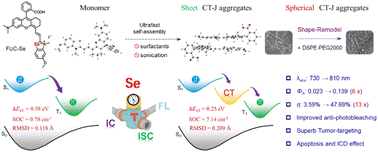
Supramolecular J-aggregation of π-conjugated photosensitizers provides a powerful strategy to optimize phototheranostic performance. However, integrating facile assembly with photodynamic and photothermal (PDT/PTT) synergy remains challenging. Herein, we report a charge transfer (CT)-state J-aggregation paradigm using a selenium-embedded molecular framework (FUC-Se). Driven by directional π–π stacking and Se⋯Se interactions, FUC-Se undergoes ultrafast (<5 s) self-assembly in water, forming stable CT-J aggregates without external triggers. Moreover, these aggregates enable concurrent amplification of reactive oxygen generation (ΦΔ = 0.139, 6 × monomer) and photothermal conversion (η = 47.69%, 13× monomer) through (i) reducing the singlet-triplet energy gap by 57% (ΔES1T1 = 0.25 eV vs. 0.58 eV) and enhancing spin–orbit coupling 9-fold (7.14 cm−1vs. 0.78 cm−1); (ii) promoting non-radiative decay with 77% surge in geometry reorganization (RMSDS1→S0 = 0.209 vs. 0.118) and 127% increase in the Huang–Rhys factor (λh = 0.25 eV vs. 0.11 eV). Phospholipid remodeling yields tumor-targeted FUC-Se@LP with hypoxia-tolerant ROS/PTT and NIR-II imaging. FUC-Se@LP achieves NIR-II-guided PDT/PTT, eradicating hypoxic tumors (IC50 = 2.47 µM) and suppressing metastasis via immunogenic cell death. This work establishes the first CT-J aggregate unifying exogenous-trigger-free ultrafast self-assembly, NIR-II imaging, and dual PDT/PTT enhancement, providing a promising strategy for precision oncology.
 Please wait while we load your content...


