


 PLATFORM UPDATE:


Exposed high-concentration Ir active sites and metal–support interaction endow Ir/MoO2-Mo2C hybrids with high atom utilization and stability for pH-universal hydrogen evolution reaction
 *a
*a
Abstract
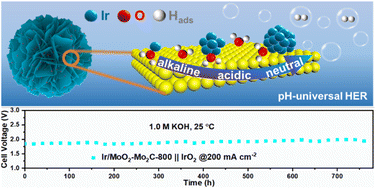
Constructing active metal–support interfacial structures is crucial for enhancing the activity and stability of electrocatalysts during the hydrogen evolution reaction (HER) across a wide pH range. Herein, ultrasmall mixed Ir species anchored on MoO2–Mo2C hollow nanoflowers assembled from nanosheets were synthesized via high-temperature sintering (600–800 °C). The X-ray absorption fine structure and X-ray photoelectron spectroscopy revealed the metal–support interaction (MSI) in Ir/MoO2-Mo2C-800. In situ attenuated total reflection surface-enhanced infrared absorption spectroscopy and in situ Raman spectroscopy reveal that Ir/MoO2-Mo2C-800 can reconstruct the distribution equilibrium of the hydrogen-bond network of interfacial water to promote water adsorption and dissociation. The highly exposed Ir active sites and MSI enable Ir/MoO2-Mo2C-800 to exhibit extremely low overpotentials of 32 (alkaline), 14 (acidic), and 29 (neutral) mV at 10 mA cm−2, respectively. Moreover, the mass activities of Ir/MoO2-Mo2C-800 (9.23, 60.99, and 8.34 A mg−1PGM) are 2.68-, 28.27-, and 3.93-fold higher than those of commercial Pt/C (3.45, 2.16, and 2.12 A mg−1PGM), respectively. The assembled Ir/MoO2-Mo2C-800 ‖ IrO2 anion-exchange membrane (AEM) water electrolyzer demonstrates stable operation for over 700/220 h at a high current density of 0.2/1 A cm−2 and Ir/MoO2-Mo2C-800 can maintain its initial morphology. This study proposes a feasible strategy to achieve highly efficient and stable pH-universal HER by developing electrocatalysts with high concentration Ir active sites and MSI engineering.
 Please wait while we load your content...


