


 PLATFORM UPDATE:


Unlocking azobenzene isomerization mechanisms via an LLM agent-driven workflow integrating simulation, experiment, and machine learning

Abstract
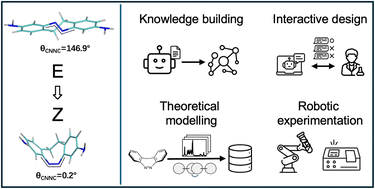
Bridged azobenzene derivatives are key photo-responsive molecular switches. However, probing and interpreting their microscopic Z ↔ E isomerization mechanisms remain challenging as isolated spectroscopic and computational efforts struggle to establish clear structure–spectrum relationships. We report an integrated, large-language-model (LLM) agent-driven workflow that links literature-guided planning, ab initio molecular dynamics (AIMD) sampling, density functional theory spectral calculations, robotic infrared/Raman measurements, and interpretable machine learning for structural–spectral analysis of bridged azobenzenes. Central to the analysis is an attention-based convolutional neural network (ATT-CNN) that predicts the C–N![[double bond, length as m-dash]](https://www.rsc.org/images/entities/char_e001.gif) N–C dihedral angle directly from vibrational spectra with r = 0.99 and MAE = 5°. Attention maps highlight mechanistically informative bands and support holistic (non-marker-dependent) interpretation; transfer learning extends performance across chemical environments and experimental datasets. LLM agents formulated the research plan and coordinated automated simulations and measurements, whereas neural-network architecture design, training, and comparative benchmarking were performed by human researchers to retain full flexibility for model exploration and ensure rigorous interpretation. To our knowledge, this is the first LLM-agent-planned and -orchestrated mechanistic study unifying literature synthesis, theory, experiment, and machine learning. The resulting strategy advances quantitative insight into azobenzene photoisomerization and provides a generalizable blueprint for AI-driven investigations of dynamic molecular systems.
N–C dihedral angle directly from vibrational spectra with r = 0.99 and MAE = 5°. Attention maps highlight mechanistically informative bands and support holistic (non-marker-dependent) interpretation; transfer learning extends performance across chemical environments and experimental datasets. LLM agents formulated the research plan and coordinated automated simulations and measurements, whereas neural-network architecture design, training, and comparative benchmarking were performed by human researchers to retain full flexibility for model exploration and ensure rigorous interpretation. To our knowledge, this is the first LLM-agent-planned and -orchestrated mechanistic study unifying literature synthesis, theory, experiment, and machine learning. The resulting strategy advances quantitative insight into azobenzene photoisomerization and provides a generalizable blueprint for AI-driven investigations of dynamic molecular systems.
 Please wait while we load your content...


