


 PLATFORM UPDATE:


Unlocking photochemical tunability in functionalised bridged-isoindigo molecular motors

Abstract
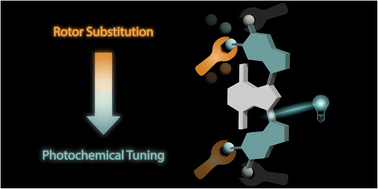
Artificial molecular machines enable precise control over motion on the molecular scale. Dual-rotor molecular motors offer unique opportunities for the development of responsive functional systems and molecular machines, yet remain considerably underexplored compared to single-rotor motors. Here, we report six new light-driven bridged-isoindigo-based dual motors, developed through strategic rotor substitution, to investigate the tunability of their rotational behaviour. While thermal processes were largely unaffected by rotor substitution, the photochemical properties were significantly influenced. All functionalised motors retained visible-light addressability, with substitution enabling additional modulation of their absorption wavelengths. Rotor functionalisation also impacted the photostationary state composition and the photochemical accessibility of specific intermediates. Notably, we made the unique observation of a photochemical generated double metastable state in light-driven molecular motors, highlighting the potential for advanced control over dual motor function. The synthetic versatility of the bridged-isoindigo scaffold was further demonstrated by the successful post-functionalisation and membrane incorporation of a representative motor, underscoring its promise for future applications in adaptive molecular systems.
 Please wait while we load your content...


