


 PLATFORM UPDATE:


Redox-mediator enhanced electrochemiluminescence under non-aqueous conditions

Abstract
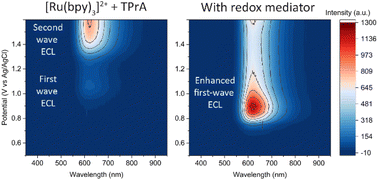
The introduction of small-molecule redox mediators into aqueous co-reactant electrochemiluminescence (ECL) systems has emerged as an effective strategy to increase signal intensity. Herein, we investigate the influence of a series of neutral iridium(III) complexes (Ir(pmi)3, Ir(ppy)3, Ir(ppz)3 and Ir(ppy)2(acac)) as redox mediators for co-reactant ECL in acetonitrile. Using [Ru(bpy)3]2+ as a benchmark luminophore and tri-n-propylamine (TPrA) as a co-reactant, the redox mediators elicit similar effects in this solvent to those of their sulfonated [Ir(sppy)3]3− and [Ir(sppz)3]3− analogues under aqueous conditions. The Ir(ppz)3 complex was most effective; at a concentration of 100 µM it produced an 11-fold increase in the maximum intensity of the ‘first wave’ ECL of [Ru(bpy)3]2+. The approach was extended to iridium(III) luminophores, where the maximum first-wave ECL intensity of [Ir(piq)2(dm-bpy)]+ was increased by up to 4-fold. As with [Ru(bpy)3]2+, the onset potential of the ECL from this luminophore and the extent to which the intensity was enhanced could be predominantly ascribed to the potential at which the mediator was oxidised. In contrast, the redox mediators were generally not effective at increasing the co-reactant ECL intensity of [Ir(df-ppy)2(dm-bpy)]+ or Ir(piq)2(acac) because the required excitation pathways were either thermodynamically inaccessible or initiated at the same potentials as competing reactions involving the direct electrochemical oxidation of the luminophore. These findings establish that neutral iridium(III) complexes can function as redox mediators in non-aqueous co-reactant ECL systems and provide mechanistic insight for extending redox-mediator-enhanced ECL to new luminophores and applications.
- This article is part of the themed collection: 2026 Chemical Science HOT Article Collection
 Please wait while we load your content...


