Supramolecular protecting groups can impart prosthetic stereoselectivity to catalytic systems employing unmodified achiral heterogenous catalysts

Abstract

Use of homogeneous catalysis – typically based on scarce precious metals – remains a dominant approach to afford good yields of enantiopure compounds. Combining typical strengths of heterogenous catalysts (low cost, sustainable, recyclable) with those of precious metal-mediated homogenous catalysis (amenability to design for selectivity) is desirable: several approaches have been demonstrated (chiral material surfaces, modification of surfaces with chiral auxiliaries, immobilisation of chiral catalysts), but it remains a challenge. Here we present a systems catalysis approach, with a heterogeneous material providing catalytic activity, and a separate host species controlling access to the catalyst to impart ‘prosthetic’ chiral selectivity. Since this non-covalent analogue to conventional covalent protecting group strategies is modular, the same substrate/host combination may be applied to a range of catalytic surfaces. The potential of this approach to achieve effective kinetic resolution is demonstrated in stereoselective synthesis of the drug (R)-cinacalcet.
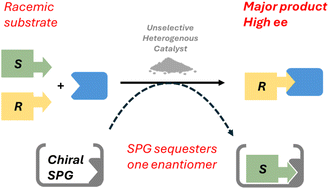
Graphical abstract: Supramolecular protecting groups can impart prosthetic stereoselectivity to catalytic systems employing unmodified achiral heterogenous catalysts

Supplementary files

Article information

Article type
Edge Article
Submitted
06 Nov 2025
Accepted
16 Feb 2026
First published
18 Feb 2026
This article is Open Access

All publication charges for this article have been paid for by the Royal Society of Chemistry
Creative Commons BY-NC license

Chem. Sci., 2026, Advance Article

Supramolecular protecting groups can impart prosthetic stereoselectivity to catalytic systems employing unmodified achiral heterogenous catalysts

B. Ivonne. Vergara-Arenas, J. Antonio. Morales-Serna and Andrew. J. Surman, Chem. Sci., 2026, Advance Article , DOI: 10.1039/D5SC08648E

This article is licensed under a Creative Commons Attribution-NonCommercial 3.0 Unported Licence. You can use material from this article in other publications, without requesting further permission from the RSC, provided that the correct acknowledgement is given and it is not used for commercial purposes.

To request permission to reproduce material from this article in a commercial publication, please go to the Copyright Clearance Center request page.

If you are an author contributing to an RSC publication, you do not need to request permission provided correct acknowledgement is given.

If you are the author of this article, you do not need to request permission to reproduce figures and diagrams provided correct acknowledgement is given. If you want to reproduce the whole article in a third-party commercial publication (excluding your thesis/dissertation for which permission is not required) please go to the Copyright Clearance Center request page.

Read more about how to correctly acknowledge RSC content.

Social activity

Spotlight

Advertisements