


 PLATFORM UPDATE:


Peptide cages: bioinspired supramolecular architectures for next-generation applications
 a
Silvia
Marchesan
*bc
a
Silvia
Marchesan
*bc
Abstract
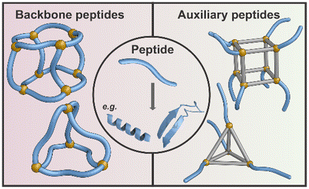
This review examines the design and synthesis of peptide-based supramolecular cages, highlighting the versatility and functional diversity achievable by incorporating small peptides as structural components. Inspired by natural supramolecular architectures, synthetic peptide cages offer unique advantages, including tunable chirality, structural predictability, biocompatibility, and ease of functionalisation. The discussion focuses on two principal strategies. The first involves cages in which peptides constitute the primary structural framework, with cage geometry dictated either by intrinsic backbone conformations or by externally imposed directional interactions such as metal coordination. The second covers hybrid systems in which peptides play a functional rather than framework-determining role and are integrated with rigid aromatic or synthetic scaffolds that define the overall architecture. These approaches enable precise control over cage geometry, cavity characteristics, and dynamic behaviour, facilitating applications in biosensing, targeted drug delivery, molecular separation, and environmental remediation. By bridging principles from natural assembly and synthetic supramolecular chemistry, peptide cages represent a powerful platform for developing next-generation functional materials.
- This article is part of the themed collection: 2026 Chemical Science Perspective & Review Collection
 Please wait while we load your content...


