


 PLATFORM UPDATE:


Inch-sized achiral perovskite ferroelectric single crystals for multiaxial passive circularly polarized light response
 *ab
*ab
Abstract
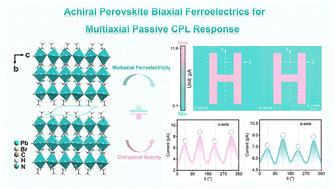
In recent years, hybrid perovskite ferroelectrics with significant spontaneous polarization features have shown prominent advantages in passive circularly polarized light (CPL) detection. Nonetheless, the successful realization of multiaxial ferroelectric semiconductors for multidirectional CPL detection under zero bias remains a considerable challenge. Herein, a multiaxial passive CPL detector is achieved, benefiting from the bulk photovoltaic effect (BPVE) in an achiral biaxial ferroelectric EA4Pb3Br10 (1, EA = ethylamine). In particular, achiral perovskite ferroelectric 1 crystallizes in a chiroptical-active polar point group (mm2) with excellent biaxial spontaneous polarization (Ps, 4.1 and 3.8 µC cm−2) to multiaxial CPL response at zero bias. In detail, a clear image of the “H” letter was obtained along the c- and a-axes, respectively, demonstrating the favourable photoelectric performance of 1. Notably, by leveraging its unique biaxial properties, the resulting device exhibits a distinct response difference of approximately 21% and 18% under right- and left-handed CPL excitation along two polar axes, comparable to many materials incorporating chiral components. It also shows excellent stability under the illumination of 405 nm CPL along both polar axes. This work represents a significant advancement in multidirectional photodetectors, highlighting the potential of multiaxial ferroelectric materials.
 Please wait while we load your content...


