


 PLATFORM UPDATE:


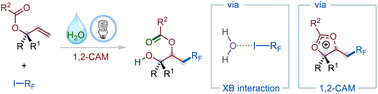
Halogen bonding-induced 1,3-carbohydroxylation of allyl carboxylates via 1,2-cationic acyloxy migration (1,2-CAM)

Abstract
Halogen bonding has emerged as a powerful yet underexplored tool for modulating radical reactivity. Here we demonstrate that halogen-bonding interactions between alkyl iodides and water can lower the C–I bond dissociation energy, enabling visible-light-induced photolysis to generate alkyl radicals under mild conditions. Harnessing this activation mode, we achieved a previously unknown 1,3-carbohydroxylation of allyl carboxylates, wherein radical addition is coupled with 1,2-cationic acyloxy migration (CAM) to furnish β-acyloxy alcohols. The transformation exhibits broad structural tolerance, accommodating diverse esters, thioesters, amides, and perfluoroalkyl iodides, and is effective in the late-stage diversification of natural products and drug-derived scaffolds. Mechanistic studies, including isotopic labeling, radical trapping, UV-vis spectroscopy, and DFT calculations, reveal a pathway in which halogen bonding initiates radical alkene addition, followed by rearrangement and carbocation capture. These findings showcase halogen-bonding-assisted photochemistry as a viable platform for radical–cationic cascades, opening new opportunities for reaction development.
 Please wait while we load your content...


