


 PLATFORM UPDATE:


Stereodivergent access to α- and β-azanucleosides via catalyst-free, achiral modulator-controlled iodocyclization: a concise synthesis of forodesine
 *abde
*abde
Abstract
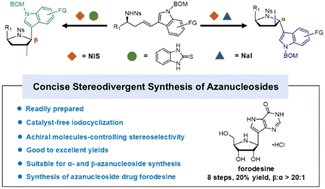
Stereoselective glycosidic bond formation remains a major challenge in nucleoside synthesis. Azanucleosides, a prominent class of nucleoside analogs wherein the sugar oxygen is replaced by nitrogen, exhibit unique biological activities but struggle to achieve anomeric selectivity in synthesis. We disclose a catalyst-free iodocyclization strategy that uses simple achiral molecules—NaI or 2-mercaptobenzimidazole—to stereodivergently access both α- and β-azanucleosides in high yields (up to 98%) with excellent stereocontrol (β : α up to β only and α : β up to 19 : 1). The utility of this method is demonstrated by a concise synthesis of forodesine in 8 steps with 20% overall yield and >20 : 1 β : α selectivity—the shortest route and highest stereoselectivity reported to date. DFT studies reveal that hydrogen bonding/Na–O coordination and π–π stacking interactions govern the stereochemical outcomes. This work provides an efficient, scalable platform for accessing diverse azanucleoside therapeutics.
 Please wait while we load your content...


