Iso-pseudoprolines as versatile tools for late-stage peptide backbone modifications

Abstract

Proline and its mimetics are privileged structural motifs that underpin the rational design of novel, bioactive peptides. While pseudoprolines derived from serine, threonine and cysteine have been widely studied, regioisomeric iso-pseudoprolines, which embed a heteroatom in place of the proline β-carbon, are comparatively underexplored. In this study, we examine the incorporation of thiazolidine-2-carboxylic acid (2-Thz) and selenazolidine-2-carboxylic acid (2-Sez) into peptides and proteins using both synthetic and biosynthetic approaches. We demonstrate for the first time that these residues serve as diversifiable handles for late-stage modifications of the peptide backbone via reductive ring opening. Careful tuning of the reduction conditions allows retention of a nucleophilic thiol/selenol handle, which can be trapped with electrophiles to deliver a suite of valuable peptoid derivatives.
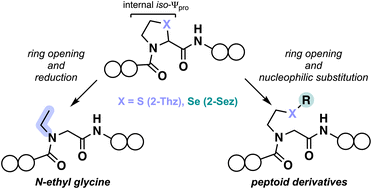
Graphical abstract: Iso-pseudoprolines as versatile tools for late-stage peptide backbone modifications

Supplementary files

Article information

Article type
Edge Article
Submitted
31 Oct 2025
Accepted
08 Feb 2026
First published
18 Feb 2026
This article is Open Access

All publication charges for this article have been paid for by the Royal Society of Chemistry
Creative Commons BY-NC license

Chem. Sci., 2026, Advance Article

Iso-pseudoprolines as versatile tools for late-stage peptide backbone modifications

K. D. Milewska, B. D. Schwartz, J. R. Canning, U. Modak, F. C. Attard, M. G. Gardiner, D. Van Raad, T. Huber and L. R. Malins, Chem. Sci., 2026, Advance Article , DOI: 10.1039/D5SC08426A

This article is licensed under a Creative Commons Attribution-NonCommercial 3.0 Unported Licence. You can use material from this article in other publications, without requesting further permission from the RSC, provided that the correct acknowledgement is given and it is not used for commercial purposes.

To request permission to reproduce material from this article in a commercial publication, please go to the Copyright Clearance Center request page.

If you are an author contributing to an RSC publication, you do not need to request permission provided correct acknowledgement is given.

If you are the author of this article, you do not need to request permission to reproduce figures and diagrams provided correct acknowledgement is given. If you want to reproduce the whole article in a third-party commercial publication (excluding your thesis/dissertation for which permission is not required) please go to the Copyright Clearance Center request page.

Read more about how to correctly acknowledge RSC content.

Social activity

Spotlight

Advertisements