


 PLATFORM UPDATE:


Confining chromophores by rigidification of polymer conformation for room-temperature phosphorescence hydrogels

Abstract
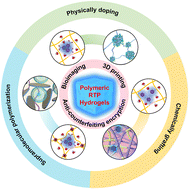
Organic room-temperature phosphorescence (RTP) materials have played an important part in several emerging photonic applications, such as flexible electronics, bioimaging, and information anti-counterfeiting encryption, due to their large Stokes shift and long lifetime. However, RTP emission of polymer materials requires restriction of a rigid chemical environment, which greatly limits their applications in the dry state, and they usually have poor stretchability. Polymeric RTP hydrogels offer excellent soft, wet features and tunable mechanical properties, providing an ideal solution to address this challenge. Various preparation strategies have been developed to achieve RTP emission by confining chromophores through polymer conformation rigidification, such as physical doping, chemical grafting, and supramolecular polymerization. This review aims to systematically summarize recent progress in this young (but flourishing) research area. Subsequently, the application fields of polymeric RTP hydrogels are reviewed briefly. The current challenges and future outlooks of this field are discussed to attract new interest and inspire more efforts.
- This article is part of the themed collection: 2026 Chemical Science Perspective & Review Collection
 Please wait while we load your content...


