


 PLATFORM UPDATE:


Nuclear quantum effects and vibrational resonances in organic hydrates: theoretical and experimental insights from DMSO monohydrate
 a
and
Giacomo
Mandelli
*b
a
and
Giacomo
Mandelli
*b
Abstract
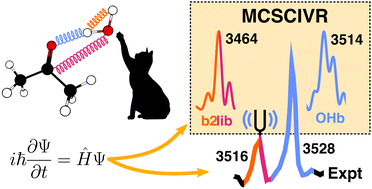
In the present work, we apply first-principles semiclassical dynamics to investigate a characteristic vibrational resonance in organic monohydrates, between the hydrogen-bonded OH stretching (OHb) and a three-quanta combination band composed of the water bending overtone coupled to a libration (b2lib). A reliable method to interpret and predict this feature would open the path to a new understanding of vibrational energy dissipation in aqueous media. Using the multiple-coherent semiclassical initial-value representation (MCSCIVR) with on-the-fly ab initio molecular dynamics, we compute vibrational densities of states that explicitly include zero-point energy, overtones, and combination bands without any ad hoc scaling procedures. Thanks to these exact quantum mechanical insights, we are able to directly observe and identify the b2lib combination band and thus the libration involved in the resonance effects. The computational procedure is further calibrated on available experimental data on acetone and cycloheptanone monohydrates. Then, it was applied to the newly obtained experimental spectrum for the dimethylsulfoxide monohydrate, provided by our collaborators Suhm and coworkers. Our results support the generality of the b2lib OHb intensity-borrowing mechanism across monohydrates and underscore the power of MCSCIVR to resolve nuclear-quantum effects in hydrated systems.
 Please wait while we load your content...


