


 PLATFORM UPDATE:


Water-mediated kinetic engineering of CTF QDs for emerging solar cells

Abstract
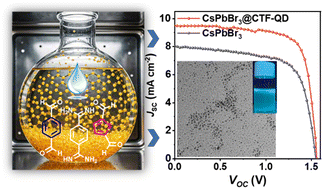
Covalent triazine framework quantum dots (CTF QDs) are promising low-toxicity, high-performance optoelectronic materials featuring molecular-level structural tunability and good charge-carrier mobility. Yet, achieving CTF QDs has long been hindered by the inherently rapid kinetics of triazine cyclization. Here, we overcome this limitation with a simple water-mediated kinetic strategy that modulates the forward Schiff-base reaction rate, thereby delaying triazine cyclization and controlling the degree of amidine–aldehyde polymerization. This approach produces CTF QDs smaller than 3 nm (denoted CTF-QD-1 and CTF-QD-2). By leveraging the pyridinic nitrogen and carbonyl oxygen-functionalized surface of CTF-QD-1 to coordinate interfacial Pb2+ in CsPbBr3 perovskites, we achieve effective defect passivation and controlled crystallization, enhancing the power conversion efficiency from 8.40% to 11.01%—a 31% relative improvement. This efficiency represents one of the highest values reported to date for all-inorganic CsPbBr3 solar cells. This kinetic engineering paradigm addresses the long-standing challenge in synthesizing CTF QDs and unlocks their potential for high-efficiency photovoltaics.
- This article is part of the themed collection: 2025 Chemical Science HOT Article Collection
 Please wait while we load your content...


