


 PLATFORM UPDATE:


Machine learning guided discovery of water stable metal–organic frameworks for photocatalytic hydrogen production

Abstract
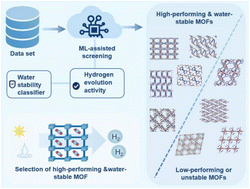
With remarkably tunable porosity and modular chemistry, metal–organic frameworks (MOFs) present a versatile platform for photocatalytic hydrogen (H2) production. However, identifying high-performing and water stable MOFs from the vast design space is challenging. In this study, we develop a hierarchical screening strategy to accelerate the discovery of photocatalytically active MOFs with robust water stability. First, machine learning (ML) classifiers are trained on experimental H2 production data to predict photocatalytic performance, achieving high accuracy and excellent transferability. Then, starting from 11660 structures in the CoRE-MOF database, 1731 are shortlisted to be photocatalytically active. Detailed structure–performance analyses reveal that linker flexibility and aliphatic character positively correlate with H2 evolution activity, while excessive aromaticity and rigidity are detrimental. Finally, a water stability classifier is applied to further identify 419 MOFs to be simultaneously photocatalytically promising and water stable. The ML-guided strategy provides a quantitative and interpretable path toward the discovery of new MOFs as photocatalysts, and it would facilitate future experimental exploration for efficient photocatalytic H2 production.
- This article is part of the themed collection: 2026 Chemical Science Covers
 Please wait while we load your content...


