


 PLATFORM UPDATE:


Hydrogen-bond-assisted meta-nitrogen-doped graphyne enables real-time electrocatalytic NADH tracking in single cells
 *a
*a
Abstract
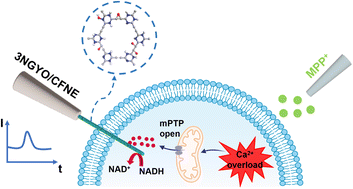
Nicotinamide adenine dinucleotide (NADH), a crucial biomarker for cellular redox homeostasis, is intrinsically linked to mitochondrial function and neurodegenerative diseases. However, electrochemical detection of intracellular NADH faces dual challenges: low abundance and biofouling, as well as high overpotential. Herein, we designed a hydrogen-bond-assisted meta-nitrogen/oxygen co-doped graphyne (3NGYO) nanoelectrode for high-performance NADH sensing. Precise tri-N doping in graphyne (3NGY) generates sp2-N atoms associated with hydrogen atoms. Specifically, pyrrolic N–H forms a 2.502 Å N–H⋯O![[double bond, length as m-dash]](https://www.rsc.org/images/entities/char_e001.gif) P hydrogen bond with NADH's PO4 groups, boosting adsorption energy to −5.48 eV and reducing NADH oxidation potential to 0 V. This achieves a 59-fold higher catalytic current response compared to pristine graphyne. Subsequent acid oxidation introduces oxygen-containing functional groups (e.g., –COOH, CO), increasing hydrophilicity (contact angle: 54.0°) and anti-fouling performance (80% current retention after 2 h BSA exposure). Electrodeposited 3NGYO nanotips attain a sensitivity of 0.419 pA µM−1 and a linear range of 0–20 µM at +0.2 V vs. Ag/AgCl. Real-time amperometry in SH-SY5Y cells demonstrates that 1-methyl-4-phenylpyridinium (MPP+)-induced mitochondrial dysfunction triggers NADH release. In contrast, hydrogen sulfide (H2S) pretreatment reduces NADH leakage by 95.4%, correlating with suppressed calcium ion (Ca2+) influx and reactive oxygen species (ROS) generation. This work provides a tool for studying mitochondrial dysfunction and establishes a new paradigm for in situ electrocatalytic biosensing.
P hydrogen bond with NADH's PO4 groups, boosting adsorption energy to −5.48 eV and reducing NADH oxidation potential to 0 V. This achieves a 59-fold higher catalytic current response compared to pristine graphyne. Subsequent acid oxidation introduces oxygen-containing functional groups (e.g., –COOH, CO), increasing hydrophilicity (contact angle: 54.0°) and anti-fouling performance (80% current retention after 2 h BSA exposure). Electrodeposited 3NGYO nanotips attain a sensitivity of 0.419 pA µM−1 and a linear range of 0–20 µM at +0.2 V vs. Ag/AgCl. Real-time amperometry in SH-SY5Y cells demonstrates that 1-methyl-4-phenylpyridinium (MPP+)-induced mitochondrial dysfunction triggers NADH release. In contrast, hydrogen sulfide (H2S) pretreatment reduces NADH leakage by 95.4%, correlating with suppressed calcium ion (Ca2+) influx and reactive oxygen species (ROS) generation. This work provides a tool for studying mitochondrial dysfunction and establishes a new paradigm for in situ electrocatalytic biosensing.
 Please wait while we load your content...


