


 PLATFORM UPDATE:

Anion-based electrolyte chemistry for sodium-ion batteries: fundamentals, advances and perspectives
 c
Xing-Long
Wu
*ab
c
Xing-Long
Wu
*ab
Abstract
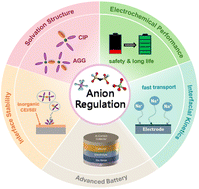
The scarcity of lithium resources and cost concerns have driven the development of sodium-ion batteries (SIBs), which utilize more abundant and lower-cost resources, as a promising alternative energy storage technology. As a key component of batteries, the electrolyte directly influences their energy density, rate capability, cycle life, and safety. However, conventional electrolytes face limitations such as poor high-voltage compatibility, inferior low-temperature performance, and unstable electrode–electrolyte interfaces, which severely hinder the commercialization of SIBs. In recent years, anion-regulated electrolytes have emerged as a research focus due to their unique anion-dominated solvation structures, demonstrating significant potential in enhancing interfacial stability, facilitating ion transport, improving high- and low-temperature performance, and strengthening safety. This review systematically elucidates the fundamental chemical characteristics and solvation structure design of anion-based electrolytes for SIBs, summarizes the influence of the mechanisms of different anion types on electrochemical performance, and explores the expanded application of anions in new systems. Finally, it outlines future directions and challenges in the field, providing valuable insights for the rational design of high-performance SIB electrolytes.
 Please wait while we load your content...


