Interface reconstruction strategy enabling the efficient light-driven amination of furfuryl alcohol

Abstract

The solar-driven photocatalytic synthesis of furfurylamine, a crucial pharmaceutical and agrochemical precursor, from renewable furfuryl alcohol, represents an energetically sustainable alternative to conventional thermal processes. Despite its promise, direct photocatalytic amination remains largely unexplored, with the current photocatalytic study predominantly focused on oxidation/reduction pathways rather than C–N bond formation. Furthermore, the deployment of biomass photoreforming is severely constrained by insufficient reaction kinetics and unsatisfactory catalytic selectivity. In this study, we present a novel reconstruction strategy to endow the catalyst with abundant active sites and greatly accelerate interfacial charge transfer. The resulting CdS/CoAl(OH)x-R catalyst achieves an exceptional furfuryl alcohol conversion rate of 76.32% with 94.78% selectivity toward furfurylamine under mild conditions. This work not only provides a practical solution for sustainable furfurylamine synthesis but also offers fundamental insights into interfacial engineering for photocatalytic C–N bond formation.
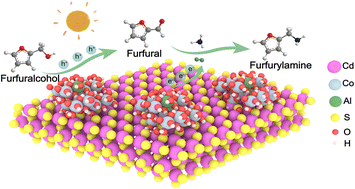
Graphical abstract: Interface reconstruction strategy enabling the efficient light-driven amination of furfuryl alcohol

Supplementary files

Article information

Article type
Edge Article
Submitted
21 Oct 2025
Accepted
08 Jan 2026
First published
19 Jan 2026
This article is Open Access

All publication charges for this article have been paid for by the Royal Society of Chemistry
Creative Commons BY-NC license

Chem. Sci., 2026, Advance Article

Interface reconstruction strategy enabling the efficient light-driven amination of furfuryl alcohol

Y. He, X. Wang, S. Ou, L. Zhu, T. Su, R. Zhang, W. Zhao, H. Huang, Z. Wang, P. Du and X. Lu, Chem. Sci., 2026, Advance Article , DOI: 10.1039/D5SC08128A

This article is licensed under a Creative Commons Attribution-NonCommercial 3.0 Unported Licence. You can use material from this article in other publications, without requesting further permission from the RSC, provided that the correct acknowledgement is given and it is not used for commercial purposes.

To request permission to reproduce material from this article in a commercial publication, please go to the Copyright Clearance Center request page.

If you are an author contributing to an RSC publication, you do not need to request permission provided correct acknowledgement is given.

If you are the author of this article, you do not need to request permission to reproduce figures and diagrams provided correct acknowledgement is given. If you want to reproduce the whole article in a third-party commercial publication (excluding your thesis/dissertation for which permission is not required) please go to the Copyright Clearance Center request page.

Read more about how to correctly acknowledge RSC content.

Social activity

Spotlight

Advertisements