


 PLATFORM UPDATE:


Designing single-atom catalysts: bridging metal–support interaction and adsorption energy optimization
 *a
*a
Abstract
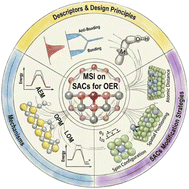
Single-atom catalysts (SACs) offer exceptional potential for the oxygen evolution reaction (OER), yet their practical application is hindered by an incomplete understanding of structure–activity relationships at the atomic scale. Traditional descriptors fail to fully explain the adsorption behavior of key oxygen intermediates, creating a fundamental gap in catalyst design. This review addresses this limitation by introducing a “structure–adsorption” framework that clarifies how metal–support interactions (MSIs) can be tuned through coordination engineering, such as spin configuration, axial coordination, and atomic distance. Our analysis demonstrates that optimal OER activity arises from a balance between orbital hybridization and electrostatic effects, providing clear design principles for next-generation SACs aimed at sustainable energy conversion.
 Please wait while we load your content...


