


 PLATFORM UPDATE:


Heteroaryl iminothioindoxyl (HA-ITI) photoswitches via regioselective aza-Wittig synthesis: unifying red-shifted absorption, large E/Z band separation, and tunable thermal recovery
 a
Carlos
Benitez-Martin,
*bc
José A.
González-Delgado,
a
Flip
de Jong,
d
Eduard
Fron,
de
Gert
Steurs,
df
Antonio J.
Martínez-Martínez,
a
Francisco
Nájera,
gh
Morten
Grøtli,
*b
Johan
Hofkens,
*di
Joakim
Andréasson
*c
and
Uwe
Pischel
*a
a
Carlos
Benitez-Martin,
*bc
José A.
González-Delgado,
a
Flip
de Jong,
d
Eduard
Fron,
de
Gert
Steurs,
df
Antonio J.
Martínez-Martínez,
a
Francisco
Nájera,
gh
Morten
Grøtli,
*b
Johan
Hofkens,
*di
Joakim
Andréasson
*c
and
Uwe
Pischel
*a
Abstract
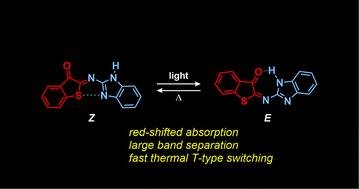
Herein we introduce heteroaryl-substituted iminothioindoxyl (HA-ITI) photoswitches featuring N-heterocyclic moieties based on indole or benzimidazole. A regioselective aza-Wittig reaction of thioisatin, previously unexplored for the synthesis of imino-based photoswitches, enabled the obtention of HA-ITI derivatives and provides an alternative and versatile synthetic access to similar analogues. HA-ITIs undergo blue light-induced Z → E photoisomerization, followed by very fast thermal E → Z back isomerization at room temperature (µs to ms timescale; resolved by transient absorption spectroscopy). Irradiation at low temperature (<200 K) provided clear proof for the reversible T-type switching of HA-ITI. This behavior was corroborated by the changes in the UV/vis absorption spectra, with λabs values around 470 nm for the thermodynamically more stable Z form and ca. 525–550 nm for the metastable E isomer. Additional compelling evidence for the Z → E photoisomerization was obtained by NMR spectroscopy of samples irradiated in situ at low temperature. The combination of NMR data, single-crystal X-ray structures, and density functional theory calculations allowed the identification of both inter- and intramolecular interactions (chalcogen and hydrogen bonding), which are present in the Z and E isomers. Balancing these interactions dictates the differential performance of the switches, resulting in the significant kinetic stabilization, from µs to ms, of the E isomer in the benzimidazole-containing photoswitch. These findings establish HA-ITIs as a modular photoswitch platform with highly desirable and tunable photochemical features, thereby broadening the synthetic and conceptual landscape of heteroaryl photoactive systems.
 Please wait while we load your content...


