


 PLATFORM UPDATE:


Highly reducible polyoxometalate–Dy(iii) SMM hybrid materials with exceptional charge stability
 a
Mathieu
Rouzières,
b
Sarah K.
Dugmore,
a
Claire
Wilson,
a
Angelos B.
Canaj,
ac
Rodolphe
Clérac
*b
and
Mark
Murrie
*a
a
Mathieu
Rouzières,
b
Sarah K.
Dugmore,
a
Claire
Wilson,
a
Angelos B.
Canaj,
ac
Rodolphe
Clérac
*b
and
Mark
Murrie
*a
Abstract
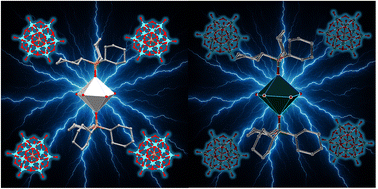
Lanthanide single-molecule magnets (SMMs) continue to draw attention as potential building blocks for ultra-dense data storage devices due to their bistable magnetic ground states and pronounced magnetic anisotropy. To realise this potential, however, a deeper understanding of how molecular magnetic memory responds to structural and environmental perturbations is critical. One essential criterion is the retention of magnetic bistability in the presence of nearby charge or charge fluctuations. Air-stable Dy(III) SMMs with pseudo-D5h symmetry are known to exhibit extremely slow magnetic relaxation, attributed to a strong axial crystal field and symmetry-imposed suppression of quantum tunnelling of magnetisation (QTM). Here we report a new high-performance, hybrid compound, [Dy(H2O)5(Cy3PO)2][Mo12PO40]·2(Cy3PO)·4THF·2H2O·Et2O (1), incorporating the bulky polyoxometalate [Mo12PO40]3− in the second coordination sphere. Upon exposure to UV light or X-rays, partial reduction of Mo(VI) to Mo(V) (ca. 3%) yields 1Red, a hybrid material that demonstrates enhanced magnetic blocking, evidenced by increased TB(Hyst) and TIRREV relative to 1. Importantly, we introduce a dilution strategy using an optically dilute, diamagnetic KBr matrix to enhance Mo reduction. This approach boosts Mo(V) content to ca. 30% in 1Red@KBr while preserving the slow relaxation dynamics of the Dy(III) complex. These results highlight the magnetic resilience of the [Dy(H2O)5(Cy3PO)2]3+ motif in charged environments and establish a basis for exploring magneto-optical and magneto-electric behaviours in SMM hybrid materials.
 Please wait while we load your content...


