


 PLATFORM UPDATE:


Cross-scale design of abiotic–biotic interfaces for semi-artificial photosynthesis

Abstract
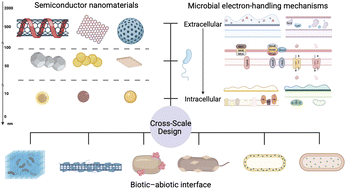
By coupling semiconductor nanomaterials with living microbes, nanomaterial–microorganism hybrid systems (NMHSs) create powerful biohybrids that unlock new routes for efficient and sustainable solar-to-chemical conversion. Central to the performance of this system is the biotic–abiotic interface, where photoelectrons must efficiently traverse from inorganic materials into complex cellular redox networks. This review highlights recent progress in understanding and engineering these interfaces across three dimensions: material architecture, microbial electron-handling machinery, and interfacial construction strategies. By dissecting how composition, size, and morphology of photosensitizers align with extracellular matrices, transmembrane conduits, and intracellular compounds, we reveal principles for minimizing interfacial resistance and maximizing charge transfer. We further classify interface communication modes into extracellular wiring, transmembrane bridging, and intracellular embedding, and evaluate corresponding construction approaches. By drawing connections between interfacial features and electron-transfer performance, we propose a multidimensional framework that integrates material engineering, microbial adaptation, and interface optimization. This perspective emphasizes the synergistic co-design of both abiotic and biotic components to achieve efficient and stable solar-to-chemical conversion, offering new opportunities for rational design of high-performance NMHSs.
- This article is part of the themed collection: 2026 Chemical Science Perspective & Review Collection
 Please wait while we load your content...


