Liquid–Liquid Phase Separation of Peptides: A Molecular Foundation for Next-Generation Biomaterials

Abstract

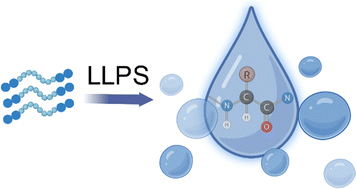
Liquid–liquid phase separation (LLPS) is a key mechanism for organizing membraneless cellular compartments, influencing processes like stress response, signaling, and gene regulation. While intrinsically disordered proteins (IDPs) and their regions (IDRs) drive LLPS through weak, multivalent interactions, the complexity of full-length proteins limits systematic design and understanding of phase separation. Peptides, as simpler modular units, offer precise control over sequence composition and provide a scalable platform for studying LLPS. Recent advancements demonstrate that peptide condensates reveal fundamental phase separation rules and enable applications such as artificial cells and drug delivery systems. This Perspective highlights recent progress in peptide LLPS, focusing on sequence design, structural characterization, and emerging applications, and discusses challenges and future directions for broader applications.
Transparent peer review

To support increased transparency, we offer authors the option to publish the peer review history alongside their article.

View this article’s peer review history

Article information

Article type
Perspective
Submitted
01 Oct 2025
Accepted
17 Dec 2025
First published
22 Dec 2025
This article is Open Access

All publication charges for this article have been paid for by the Royal Society of Chemistry
Creative Commons BY-NC license

Chem. Sci., 2026, Accepted Manuscript

Liquid–Liquid Phase Separation of Peptides: A Molecular Foundation for Next-Generation Biomaterials

L. Lu and H. Wang, Chem. Sci., 2026, Accepted Manuscript , DOI: 10.1039/D5SC07607B

This article is licensed under a Creative Commons Attribution-NonCommercial 3.0 Unported Licence. You can use material from this article in other publications, without requesting further permission from the RSC, provided that the correct acknowledgement is given and it is not used for commercial purposes.

To request permission to reproduce material from this article in a commercial publication, please go to the Copyright Clearance Center request page.

If you are an author contributing to an RSC publication, you do not need to request permission provided correct acknowledgement is given.

If you are the author of this article, you do not need to request permission to reproduce figures and diagrams provided correct acknowledgement is given. If you want to reproduce the whole article in a third-party commercial publication (excluding your thesis/dissertation for which permission is not required) please go to the Copyright Clearance Center request page.

Read more about how to correctly acknowledge RSC content.

Social activity

Spotlight

Advertisements