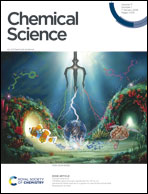
Engineering O–O formation on dual-atom Fe–Mo catalysts for oxygen electrocatalysis

Abstract

Although single-atom Fe–N–C catalysts exhibit outstanding oxygen reduction reaction (ORR) activity, their stability presents challenges due to the oxidation and destruction of Fe–Nx active sites by Fenton-like reactions, severely restricting their application in energy storage and conversion technologies. Here, we construct a dual-atom oxygen electrocatalyst (FeMo/NC) with FeMoN7 active sites, which demonstrates excellent bifunctional oxygen electrocatalysis performance. The FeMo/NC-based zinc–air battery (ZAB) can operate continuously for over 200 h without significant activity decay, making it superior to the Fe/NC-based ZAB. In situ X-ray absorption spectroscopy (XAS) and Raman characterizations reveal the formation of the *Fe–O–O–Mo* intermediate with an oxygen bridge bond, which synergistically enables adsorption or desorption of O2 through the Fe–Mo dual-atom sites, avoiding the limitations of the linear scaling relationship and thereby accelerating the oxygen electrocatalysis process. Density functional theory calculations reveal that the bridged oxygen adsorption mode on the Fe–Mo dual-atom sites exhibits lower energy barriers compared to that on single Fe/Mo sites, favoring the oxygen electrocatalysis.

Graphical abstract: Engineering O–O formation on dual-atom Fe–Mo catalysts for oxygen electrocatalysis

Supplementary files

Article information

Article type
Edge Article
Submitted
23 Sep 2025
Accepted
02 Nov 2025
First published
03 Nov 2025
This article is Open Access

All publication charges for this article have been paid for by the Royal Society of Chemistry
Creative Commons BY-NC license

Chem. Sci., 2026, Advance Article

Engineering O–O formation on dual-atom Fe–Mo catalysts for oxygen electrocatalysis

L. Qi, Y. Tang, T. Gan and J. Guan, Chem. Sci., 2026, Advance Article , DOI: 10.1039/D5SC07373A

This article is licensed under a Creative Commons Attribution-NonCommercial 3.0 Unported Licence. You can use material from this article in other publications, without requesting further permission from the RSC, provided that the correct acknowledgement is given and it is not used for commercial purposes.

To request permission to reproduce material from this article in a commercial publication, please go to the Copyright Clearance Center request page.

If you are an author contributing to an RSC publication, you do not need to request permission provided correct acknowledgement is given.

If you are the author of this article, you do not need to request permission to reproduce figures and diagrams provided correct acknowledgement is given. If you want to reproduce the whole article in a third-party commercial publication (excluding your thesis/dissertation for which permission is not required) please go to the Copyright Clearance Center request page.

Read more about how to correctly acknowledge RSC content.

Social activity

Spotlight

Advertisements