


 PLATFORM UPDATE:


Optical write–erase chemical memory state in plasmonic nanoarrays
 *a
Dylan
Wilkinson,
a
Paula L.
Lalaguna,
a
Affar S.
Karimullah,
a
Nikolaj
Gadegaard,
b
Graeme
Cooke
a
and
Malcolm
Kadodwala
*a
*a
Dylan
Wilkinson,
a
Paula L.
Lalaguna,
a
Affar S.
Karimullah,
a
Nikolaj
Gadegaard,
b
Graeme
Cooke
a
and
Malcolm
Kadodwala
*a
Abstract
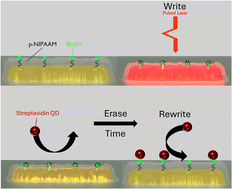
Plasmonic nanoarrays coated with a thermoresponsive self-assembled monolayer (SAM) operate as an optically programmable write–erase chemical memory. Optical addressing through pulsed laser illumination writes a collapsed interfacial state, the SAM stores this state for days, and passive rehydration erases it to restore chemical functionality. Unlike previous PNIPAM systems, where laser-induced collapse is transient on nanosecond–minute timescales, the SAM forms a kinetically trapped, long-lived state that enables durable storage of chemical information. By tuning the wavelength and polarisation of uniform illumination, individual nanoarrays can be addressed selectively. Switching is detected through spectral shifts in the localised surface plasmon resonance and suppression of biomolecular binding, and supported by electromagnetic and transient thermal simulations based on measured nanostructure geometries. These results establish a general framework for multiplexed, optically programmable write–erase surface chemistry, opening routes to erasable nanofabrication strategies and multiplexed biosensing.
 Please wait while we load your content...


