Simple s-block metal hydrides for selective hydrogenation of quinoline compounds

Abstract

For many decades, selective hydrogenation of N-heterocycles using H2 has been considered the exclusive domain of d-block metals. Herein, a series of solid-state s-block metal hydrides is demonstrated to function as transition-metal-free catalysts for the hydrogenation of quinoline, affording high yields of 1,2,3,4-tetrahydroquinoline. Under relatively mild conditions, the catalytic performance of the representative barium hydride (BaH2) is good enough to compete with some recently developed Fe, Co, Ni catalysts. Moreover, this transformation is remarkably simple and does not need any sophisticated ligands, co-catalysts, and additives compared with the existing methodology. Mechanistic studies reveal that the quinoline substrate can activate BaH2in situ, generating a catalytically active organobarium hydride species that effects the hydrogenation process. With the aid of theoretical modeling, the synergistic scenario between the Lewis acidic barium cation and the nucleophilic hydride anion in regioselective hydrogenation of quinoline is delineated, which shows a working principle distinct from the conventional transition metal catalysis. These findings provide insights into the discovery of new catalysts and/or reactivity that is complementary to that of transition metals.
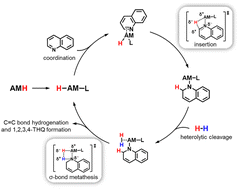
Graphical abstract: Simple s-block metal hydrides for selective hydrogenation of quinoline compounds

Supplementary files

Transparent peer review

To support increased transparency, we offer authors the option to publish the peer review history alongside their article.

View this article’s peer review history

Article information

Article type
Edge Article
Submitted
17 Sep 2025
Accepted
11 Nov 2025
First published
11 Nov 2025
This article is Open Access

All publication charges for this article have been paid for by the Royal Society of Chemistry
Creative Commons BY-NC license

Chem. Sci., 2026, Advance Article

Simple s-block metal hydrides for selective hydrogenation of quinoline compounds

S. Zhang, H. Wen, Q. Wang, Y. Cai, Z. Li, L. Liu, X. Chang, J. Guo and P. Chen, Chem. Sci., 2026, Advance Article , DOI: 10.1039/D5SC07195J

This article is licensed under a Creative Commons Attribution-NonCommercial 3.0 Unported Licence. You can use material from this article in other publications, without requesting further permission from the RSC, provided that the correct acknowledgement is given and it is not used for commercial purposes.

To request permission to reproduce material from this article in a commercial publication, please go to the Copyright Clearance Center request page.

If you are an author contributing to an RSC publication, you do not need to request permission provided correct acknowledgement is given.

If you are the author of this article, you do not need to request permission to reproduce figures and diagrams provided correct acknowledgement is given. If you want to reproduce the whole article in a third-party commercial publication (excluding your thesis/dissertation for which permission is not required) please go to the Copyright Clearance Center request page.

Read more about how to correctly acknowledge RSC content.

Social activity

Spotlight

Advertisements