


 PLATFORM UPDATE:


Aggregation favors singlet formation in TES-ADT triplet annihilator for photon upconversion
 a
Edvinas
Radiunas,
a
Augustina
Jozeliūnaitė,
b
Edvinas
Orentas
b
and
Karolis
Kazlauskas
*a
a
Edvinas
Radiunas,
a
Augustina
Jozeliūnaitė,
b
Edvinas
Orentas
b
and
Karolis
Kazlauskas
*a
Abstract
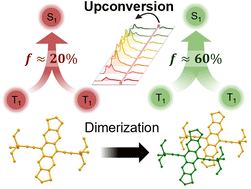
Triplet–triplet annihilation (TTA)-mediated photon upconversion (UC) offers a promising route for transforming low-energy photons into higher-energy ones under low-power, incoherent excitation, with applications in photovoltaics, bioimaging, 3D printing, etc. However, a central constraint on UC efficiency is the limited spin-statistical factor (f), which dictates the yield of singlet state formation and is especially challenging in the desirable far-red/NIR spectral range. Here, we explore a new approach of tuning the annihilator's f factor through controlled aggregation. The study covers a systematic investigation of triethylsilyl-substituted anthradithiophene (TES-ADT) annihilator solutions across a range of concentrations, complemented by studies on a neat TES-ADT film and density functional theory (DFT) calculations. We report a remarkable 3-fold enhancement in singlet yield, boosting the f value from ca. 20% to an impressive ca. 60% upon increasing annihilator concentration, which is shown to be directly linked to annihilator aggregation. DFT calculations further suggest that dimerization-induced shifts in energy levels and the accessibility of higher-energy triplet states (up to T6) facilitate spin-conversion processes. Our findings unveil aggregation-enhanced singlet generation via TTA in TES-ADT, providing a valuable insight for designing more efficient UC systems by tailoring energy landscapes through molecular packing.
 Please wait while we load your content...


