


 PLATFORM UPDATE:


Efficient singlet fission in rubicene null aggregates

Abstract
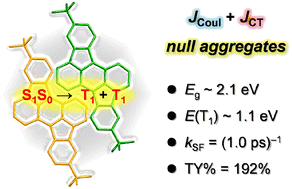
The singlet fission (SF) photovoltaic applications are currently restricted by the limited number of practical SF materials and the lack of understanding of the underlying SF mechanism in typical molecular aggregates. Null-aggregates are molecular aggregates that exhibit minimal exciton–exciton interactions, leading to a monomer-like spectroscopic signature, and thus hold distinct advantages in bypassing extra energy loss and excimer trap issues in conventional H- and J-aggregates. However, it remains unknown if null-aggregates could also contribute to an efficient SF process. In this work, we present an efficient SF system based on rubicene null aggregates. The comprehensive structural and spectroscopic studies demonstrate that the destructive interference between long-range Coulomb and short-range charge-transfer (CT) couplings leads to the monomer-like absorption characteristics of the null aggregates. More importantly, the significant CT coupling interactions contribute to an efficient SF process with a SF rate of (1.0 ps)−1 and a triplet yield of 192% in the null aggregates. Our findings not only provide a deep insight into the SF mechanism in the special null aggregates but also offer a robust SF material system with suitable energies, which would open up a new avenue for the future molecular design and device applications.
 Please wait while we load your content...


