


 PLATFORM UPDATE:


Lanthanide complexes with acetophenone-based push-pull antennas as efficient MRI and two-photon microscopy imaging probes
 d
Akos
Banyasz,
e
Sandra
Même,
c
Didier
Boturyn,
b
Véronique
Martel-Frachet,
fg
Alexei
Grichine,
f
Olivier
Maury,
e
Magali
Gary-Bobo,
*d
Célia S.
Bonnet
*c
and
Olivier
Sénèque
*a
d
Akos
Banyasz,
e
Sandra
Même,
c
Didier
Boturyn,
b
Véronique
Martel-Frachet,
fg
Alexei
Grichine,
f
Olivier
Maury,
e
Magali
Gary-Bobo,
*d
Célia S.
Bonnet
*c
and
Olivier
Sénèque
*a
Abstract
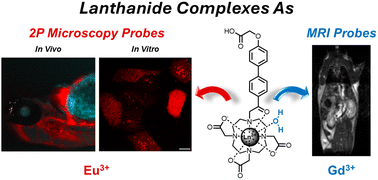
Lanthanide(III) (Ln3+) complexes possess unique magnetic and optical properties that make them ideal candidates for the development of multimodal MRI and optical probes. However, the requirements for developing effective MRI and optical probes are difficult to meet within a single ligand. Here, we propose the use of a DOTA-type ligand equipped with a π-extended acetophenone moiety that (i) serves as a coordinating moiety to form stable Ln3+ complexes, (ii) acts as a 2P-excitable push–pull antenna to sensitize Eu3+ luminescence, and (iii) displays a carboxylate handle offering high water solubility and enabling conjugation to biomolecules for targeting purposes. We show that the Ln3+ complexes obtained are kinetically inert and thermodynamically stable. The Gd3+ complex exhibits positive in vivo characteristics with good contrast in all organs and rapid renal clearance, while the corresponding Eu3+ complex has excellent one-photon and two-photon (2P) absorption properties enabling high-quality in vivo 2P microscopy imaging of zebrafish embryos or in vitro imaging of living cells when conjugated to a cell-penetrating peptide.
 Please wait while we load your content...


