


 PLATFORM UPDATE:


Plasmonically enhanced Fe(ii) coordination complexes allow SERS readout of spin state switching below the optical diffraction limit

Abstract
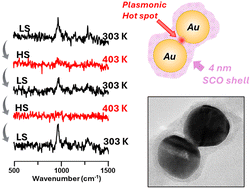
Creating and monitoring spin crossover (SCO) materials at the nanoscale is challenging since the spin transition phenomena are perturbed and methods for monitoring them are limited. Optical approaches for monitoring nanoscale SCO are attractive but limited by weak signal levels. Here, we demonstrate for the first time that surface enhanced Raman spectroscopy (SERS) allows enhanced readout of spin state transitions of even <1 µm SCO nano-objects confined within plasmonic nanovoids. Pressing dry crystalline [Fe(Htrz)2(trz)](BF4) (1) into the nanogaps between sheets of metal nanoparticles gave strong SERS signals but was unsuccessful since the surface perturbed the spin transition behaviour. However, when 1 was placed in the plasmonic hotspots between the Au cores in clusters of Au@SCO core–shell nanoparticles, SCO was retained and could be monitored using SERS. Importantly, the clusters showed thermal hysteresis loops which, although narrower than that of bulk 1 (9 K vs. 40 K), demonstrated that cooperative behaviour was retained in the nanovoids.
 Please wait while we load your content...


